
Read the Isabella County Tax Record Fields
Isabella County splits the work. Equalization surveys local assessments and explains Michigan's value rules. The Treasurer handles county tax functions, foreclosure, parcel information, and delinquent payment routes, while current collection often stays with a city, village, or township.
| Field | What It Shows | Where |
|---|---|---|
| Assessed value | Annual assessment at Michigan's required level | Assessment roll / BS&A |
| State Equalized Value | Equalized assessment figure, often shown as SEV | Assessment record |
| Taxable value | Value to which mills are applied | Assessment and tax record |
| Principal Residence Exemption | Qualified school operating tax reduction | Assessment record |
| Current tax status | Bill year and payment information | Tax Information tab / collector |
| Delinquent status | Arrears and payoff route | Delinquent Tax Information tab |
Michigan assesses property annually at 50 percent of market value. Proposal A can cap taxable value below that figure. The bill applies mills to taxable value. Neither that tax base nor the bill amount is what a buyer would necessarily pay.
Find Isabella Tax Records in BS&A
The county parcel-information page points searchers to BS&A and lists the three inputs it needs. The live card layout varies, so record the fields shown on your result and note the year.
| Search field | Use | Check |
|---|---|---|
| Parcel Number | Direct parcel match | Number and format |
| Name | Owner listed on roll | Spelling and jurisdiction |
| Address | Physical property | Situs versus mailing address |
Open Tax Information for the year you need. Use Delinquent Tax Information for arrears or payoff amounts. The county cautions that FetchGIS tax data may be historical, so a GIS label should never replace BS&A or a call to the collector.
Trace an Isabella County Tax Bill
Start with the official Isabella County BS&A portal, working through the parcel and tax tabs, and confirm who collects the current bill. July and December bills follow the calendar-year tax cycle.
- Search by parcel number when possible, or use the address and confirm the municipality.
- Open the correct tax year and copy taxable value, listed mills, charges, payments, and balance.
- Check the assessment record for PRE or agricultural treatment that affects the bill.
- Use the delinquent tab and Treasurer route for arrears, payoff, forfeiture, or foreclosure status.
- Save the access date and call the published collector before a deadline or closing.
- Assessed value
- The assessor's value before Proposal A taxable-value limits are applied.
- Taxable value
- The value multiplied by the millage rate for the tax calculation.
- Mill
- One dollar of tax for each $1,000 of taxable value.
- Principal Residence Exemption
- Qualified relief from up to 18 mills of school operating tax.
- Tax lien
- A claim arising from unpaid property tax.
Separate Isabella SEV from Taxable Value
Proposal A created Michigan's taxable-value system in 1995. Taxable value generally rises by inflation or 5 percent each year. Whichever is less applies. It cannot exceed SEV until a transfer occurs. After a transfer, the cap comes off the following year. That timing explains a puzzle for recent buyers. A large change can follow closing even though the sale date and the new taxable figure do not appear at once.
Assessors rely on mass appraisal, sales data, the state cost manual, and neighborhood factors, according to Equalization. One property's sale price cannot stand alone as the basis for its assessment. Compare class and condition against truly similar parcels. Tell a market disagreement apart from a plain data error. The official Equalization FAQ covers these points in the county's own words.
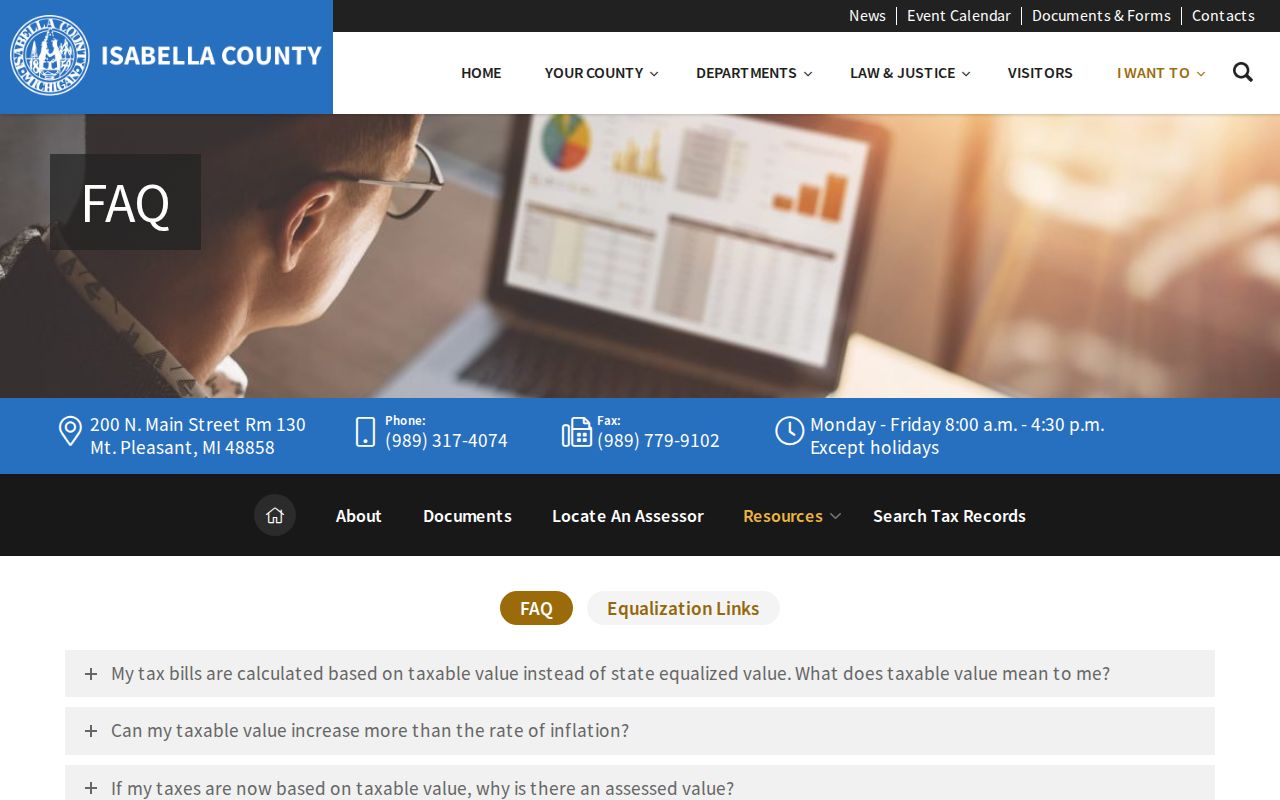
The county's own explanation governs the 50-percent assessment level, Proposal A limits, PRE, and the appeal sequence.
Check Isabella PRE and Agricultural Forms
A qualified legal primary residence can earn a Principal Residence Exemption from up to 18 mills of school operating tax. The county names Form 2368 and a May 1 filing deadline. Rescissions use Form 2602 within 90 days once the property no longer qualifies.
Qualified Agricultural treatment runs through Form 3677. The county warns that recapture can reach back the latest seven years. Classification, exemption, and taxable value are separate fields. Know which one is disputed before filing a form or appeal.
Identify the Right Isabella Tax Collector
The county Treasurer does not collect every current summer or winter bill. County guidance describes online summer and delinquent payment availability for Lincoln and Rolland townships. It routes many other current taxes to the relevant township, city, or village. It also notes that the Treasurer no longer collects Coe Township summer taxes.
Payments made online outside normal hours post the next business day. The county lists a 2.95 percent convenience fee. Confirm the collector, due date, balance, and posting rule before paying anything. A receipt or pending screen is not a posted zero balance.
Note: A mailing city does not set the taxing jurisdiction. Verify the municipality attached to the parcel.
Calculate an Isabella Bill from Taxable Value
The county's basic formula is taxable value multiplied by mills, divided by 1,000. A final bill can still differ. Listed millages, exemptions, special charges, prior balances, interest, or fees vary by parcel and year. Read each taxing line rather than comparing totals alone. A July bill and a December bill belong to one calendar-year cycle. Save both for any sale, reimbursement, or delinquency question.
Follow Isabella Delinquency to Tax Foreclosure
Delinquent status belongs in the BS&A delinquent tab. It also belongs in the Treasurer's official foreclosure materials, never in a historical GIS label. Michigan's post-1999 tax-reversion process moves unpaid property through forfeiture and judicial foreclosure. A tax lien, forfeiture, foreclosure judgment, auction listing, and deed are separate records. Each sits at a separate stage.
The county has announced an August 2026 tax sale. It expects the next one in August 2027. Surplus-proceeds claims use Form 5743 and strict published procedures. Those dates shift, so recheck the official foreclosed-properties page instead of trusting an old notice.
A fake Planning & Zoning bill circulated in April 2026, and it holds a payment lesson. Verify sender domains. Call the county-published Treasurer number, (989) 317-4091, before paying an unexpected demand.
Contest an Isabella County Assessment
The notices usually arrive in late February or early March. Each one states the local Board of Review dates. Start by calling the local assessor. The assessor can correct facts and explain how the valuation was built. The March Board of Review is the next step. Isabella County notes that this step preserves Michigan Tax Tribunal appeal rights.
Bring the notice and the parcel card. Add photographs, condition facts, and sale information for comparable property. Add a short explanation of the correction you want. Check the exact local schedule through Equalization's assessor locator and Board of Review resources. Isabella County publishes no single countywide appeal date that replaces each local board's posted schedule.
Protect the appeal window. Contact the local assessor first, then follow the March Board of Review dates printed on the notice to preserve further appeal rights.
Payment disputes, exemption forms, and value appeals are different tracks. Read the notice carefully and route each issue to the office that controls that specific record.
Take Isabella Tax Questions to the Correct Office
Equalization, the local assessor, the Treasurer, and a local tax collector each handle a different piece of the property tax system. Equalization keeps the annual assessment system consistent across local units. The assessor prepares each parcel assessment and takes the first question about value. The Treasurer handles county tax, delinquency, foreclosure, and payoff routes. A city, village, or township may collect the current bill.
The Isabella County Treasurer lists 200 N Main with a relocation notice to 510 W Pickard Street in Mount Pleasant, phone (989) 317-4091, and weekday hours from 8 a.m. to 4:30 p.m. Equalization sits at 200 N Main, Room 130, phone (989) 317-4074, with the same listed weekday hours. Confirm the current location and hours before visiting.
When a portal leaves out a public record you need, a written Michigan FOIA request can describe the parcel, the tax year, the record type, and the format you want. Michigan FOIA ordinarily requires a response within five business days and allows a written extension of up to ten business days. Court files follow court access rules instead.
Audit an Isabella Property Tax Record Before Use
Start by matching the parcel number and jurisdiction. Then match the tax year, bill season, taxable value, and exemption status. Confirm whether a payment has posted. Check whether a separate delinquent balance exists too. A portal view outside business hours may not reflect an online payment. It may not update until the next business day.
Compare the deed date with the assessment year after a transfer. Taxable value uncaps in the following year. If the owner name looks stale, use the latest recorded deed as the transfer check. If the amount seems wrong, do not call right away. First separate a valuation concern from an exemption, millage, posting, or delinquency concern.
Save the official URL and the access date. Isabella County property tax records change often. They shift with payments, corrections, Board of Review action, and annual rolls. A dated copy shows the office what the searcher saw. That prevents an older screen from being treated as the current balance.
Keep the receipt or confirmation number separate. A displayed balance and proof of payment serve different purposes. This matters especially when a payment made after hours posts the next business day.