
Isabella County Owner-of-Record Card
The Isabella County BS&A roll is the starting point for a present owner. Search works by parcel number, name, or address. A full live card may not display at once, so read the current labels and field order straight from the result. Transcribe the Owner or Owner Name field exactly.
| Owner or Owner Name | Name carried on the assessment roll |
|---|---|
| Mailing Address | Destination for assessment or tax notices |
| Situs Address | Physical location of the parcel |
| Parcel Number | Cross-office land identifier |
| Legal Description | Subdivision, lot, section, or other land clue |
| Tax and Value Tabs | Year-specific administrative context |
An owner-of-record field is not an occupant list. The mailing address may point elsewhere. An entity may hold the deed. Save the result date, parcel number, and legal description before comparing sources.
The official Isabella County BS&A portal provides the roll-search entry point.
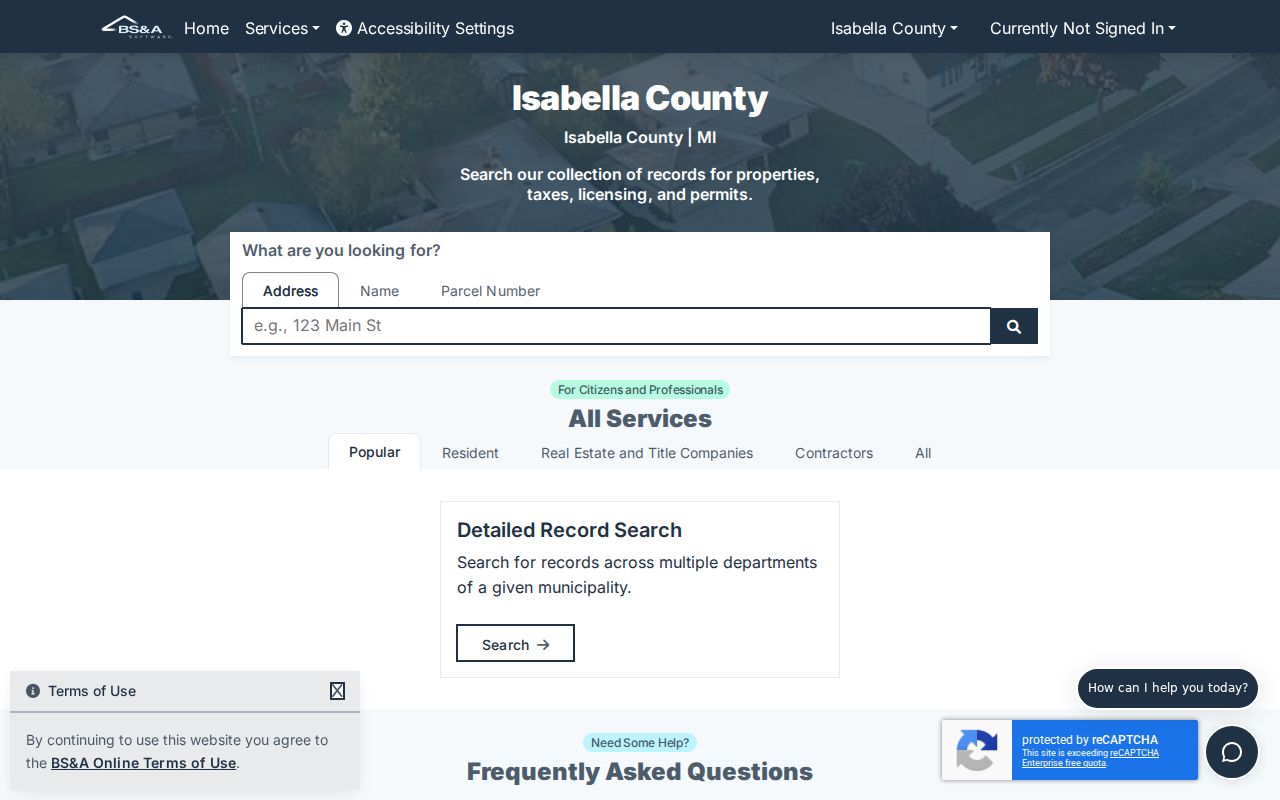
The screen shows the address, name, and parcel search paths.
Isabella County Roll Freshness
Isabella County publishes no refresh interval or closing-to-roll lag. Assessments are annual. Under Proposal A, taxable value is uncapped in the year after a transfer. That rule sets no owner-change date. A closing can happen before the roll catches up, so note the roll year and access date, then search for a newer deed. If names differ, the newest matching recorded conveyance is the stronger evidence of the latest public title event.
Recent-sale gap. The roll may trail a closing. Compare it with the latest recorded deed before naming Isabella County's current owner.
Confirm Isabella County's Current Owner
The Register of Deeds PublicSearch takes a grantor or grantee, subdivision, document type, or document number in its Search Term field. A recorded-date range is available too. Index-only and full-text OCR modes round out the options. Use the owner name and parcel clues together to locate the newest matching conveyance.
- Read the exact owner field, parcel number, and legal description in BS&A.
- Search that name as grantee and narrow the recorded-date range.
- Compare the newest deed's legal description with the parcel, not just the name.
- Check for a later deed, probate instrument, split, or combination.
- Owner of record
- The party named on the administrative roll.
- Vesting
- The form in which an interest is held by a person, trust, or entity.
- Recording lag
- Time between a transaction and its appearance in another public system.
Isabella County Owner Addresses
Mailing and situs fields serve different roles. The situs locates the land. The mailing address directs notices to the owner. A mailing city can cross a municipal line near Mount Pleasant, Lake Isabella, Shepherd, or one of the county townships.
Confirm jurisdiction in FetchGIS and identity through the legal description. Neither field proves the owner lives at the parcel. The mailing line is a contact clue, not an occupancy finding.
Keep both addresses and label them when they differ. A tax notice may go to another Michigan community or out of state while the owner still holds the Isabella County parcel. A local mailing address proves nothing either. Use the parcel number to keep later deed and GIS map checks tied to the same land.
Isabella County Entity Owners
The current grantee may be an LLC, corporation, trust, estate, survivor, or trustee. Copy the full name, suffixes and all. The Michigan LARA corporations service confirms a company's legal name and status. It never makes an officer the landowner.
Probate transfers bring their own instruments. An affidavit, proof of death, order, personal-representative deed, or heir deed may carry the transfer. Search the latest land instrument first. Use the 37th Probate Court when needed.
Entity wording can shift between records. Search the full legal name first. Try abbreviations and punctuation variants next. For a trust, check both the trustee's name and the trust name on the instrument. Isabella County recording guidance notes that proof of death can be required with survivor language, and a separate trust agreement may be required in some circumstances. That is why the recorded file can hold more context than the tax-roll label.
Isabella County Parcel Changes
A split can make a correct name look wrong. A successor parcel may carry a new identifier while its description refers to predecessor land. Compare present and former descriptions, the recorded split or combination instruments, and the plat.
Lot, block, and section-township-range terms survive address changes. The official S-T-R index helps normalize plat names. The recorded deed remains the title evidence.
If BS&A shows a current owner under a successor parcel, search the deed index with both current and predecessor description clues. The transfer may cover only part of the tract. The map shows the new shape. The recorded split, combination, deed, or plat explains how that shape entered the record. Matching those facts keeps one owner's name off land carved away in an earlier transaction.
Isabella County Counter Confirmation
When the latest deed is not online, visit the Register of Deeds counter at 200 N Main Street, Room 220, Mount Pleasant. Call (989) 317-4089 to verify hours. Open land records can be reviewed or copied during business hours. Printed copies run $1 per page. The account-based search service covers pre-1940 and tract/grid searching. Electronic certification adds $5 for eligible records, and some redacted documents cannot be certified that way, so ask which copy channel fits.
Isabella County Current-Owner Checklist
A current-owner note earns trust only when it shows its work. Capture the owner of record exactly as the roll prints it. Include the parcel number, situs, and the township or municipality. Jot down the source office too. Add the legal description or a subdivision clue if the roll supplies one. Then chase the newest matching deed in the deed records. Its date, grantee, document number or liber and page, and deed type all belong on the card.
Read the two records in order. A deed newer than the tax roll means both names stay. Add a note explaining the date gap. Mismatched legal descriptions are a red flag. Resolve the parcel identity before making any owner claim. Entity names that differ only by punctuation or a suffix deserve a legal-entity check. Do not merge them silently. This modest card keeps a present-tense ownership statement anchored to its property records.
Tax data can add a useful year marker, but it never replaces the conveyance. The Treasurer cautions that FetchGIS tax information may be historical. Confirm current tax status through BS&A or the office itself. That caution is one more reason every Isabella County owner result needs a date beside it.
Request Isabella County Owner Records
Michigan FOIA opens a route to any describable, non-exempt record a public body holds. The clock usually runs five business days. A written extension of up to ten more business days is possible. Name the record, the parcel, the date span, and the office in the request. Staff will pull documents, not opinions. Ask them to decide who owns the property and the request goes off the rails. The same goes for assembling a title report.
Try the ordinary portal or counter first, since anything already open there answers faster. A focused request suits the agency record that never made it online. Exemptions and fees still apply. The Register of Deeds, Equalization, the Treasurer, and the local assessor each keep a different slice of the property file. Aim the request at the actual custodian of the Isabella County property records you need.
Use Isabella County Owner Data Lawfully
The public mailing field is the standard written-contact clue attached to the tax roll. Use only what a lawful property question requires. Never publish private identifiers or chase a protected address. Michigan's Address Confidentiality Program can give eligible survivors a designated address instead.
Commercial indexes go stale, and some merge same-name people into one phantom owner. Lean on official land records instead. Corrections to a government record go to its custodian. That means using the proper deed, assessment, or statutory process.
Lawful use. Isabella County owner data supports property matters and civic research. Never use it to target, intimidate, or harass a person.