
Start an Isabella County Property Records Search
Most lookups turn on three keys. They are the street address, the owner name, and the parcel number. An address is the easiest starting point in BS&A Online. A name helps when one owner holds more than one parcel. The parcel number is the strongest key of all. It carries a result from the tax roll to the GIS map. It also confirms that a deed's legal description covers the same land.
No single screen answers every question. The assessment roll is an administrative tax record. A recorded deed, by contrast, is evidence in the public title trail. A line on the GIS map is only a cartographic aid. When the stakes are real, get a certified instrument. Or obtain professional title and boundary work rather than trust a single screen.
- Search BS&A by address and record the parcel number, owner name, legal description, and tax year.
- Use the Register of Deeds index to locate the latest conveyance and any recorded mortgages, liens, or easements.
- Read current tax information in BS&A or confirm delinquency with the Treasurer.
- Open FetchGIS to view the parcel in relation to roads, zoning, land use, and nearby parcels.
- Request a certified copy or use the office, library, and archive routes when the online record is incomplete.
The Desks Behind Isabella County Property Records
Mount Pleasant is the county seat. Most offices maintaining Isabella County property records share that counter space. The Register of Deeds records title instruments. Equalization supports assessment work, local assessors set the roll, and the Treasurer collects taxes and handles delinquencies. Community Development keeps the county GIS resources. The functions overlap around one parcel, but their records are never interchangeable.
Isabella County Register of Deeds
200 N. Main Street
Mount Pleasant, MI 48858
989-317-4089
Isabella County Equalization
200 N. Main Street
Mount Pleasant, MI 48858
989-317-4074
Isabella County Treasurer
200 N. Main Street
Mount Pleasant, MI 48858
989-317-4091
PublicSearch Opens Isabella County's Recorded-Document Index
Quick Search and Advanced Search anchor the portal. The official Isabella County PublicSearch portal accepts a grantor or grantee, a subdivision, a document type, or a document number in its Search Term box. A recorded-date range narrows results. Index fields and full-text OCR are both options. OCR can pull a phrase from a legal description, though it also misses faint or unusual print.
| Search control | Best use | Check after searching |
|---|---|---|
| Grantor or grantee | Follow a named party | Legal description and dates |
| Subdivision | Find instruments tied to a plat | Lot, block, section, and range |
| Document number or type | Retrieve or filter an instrument | Recording stamp and parties |
| Index or OCR | Search catalog fields or image text | Read the actual image when available |
The index is certified through September 9, 2026. That date describes the displayed index only. It is no promise that every image or historic record sits online, and the portal does not state its earliest online year.
BS&A Links Isabella County Property Records by Parcel
The county's own parcel instructions point users to BS&A Online. That service accepts a parcel number, name, or address. A useful result shows the owner field, property and mailing addresses, the parcel number, and the legal description. Assessed and taxable values appear alongside tax tabs. Note the tax year shown on screen. A recent closing may not have reached the roll yet.
- Parcel number
- The shared identifier used to cross-check the tax roll, GIS, and legal description.
- Assessed value
- Michigan's tax assessment measure, generally set at 50 percent of true cash value.
- Taxable value
- The value to which millage is applied after Proposal A rules and any exemption treatment.
- Legal description
- The land description that ties the administrative parcel to a deed or plat.
FetchGIS tax data can be historical. The Treasurer says so directly, so use BS&A or the Treasurer for current tax status rather than treating the map as the payment ledger.
Which Isabella County Property Record Answers Which Question
Not every record serves every purpose. Isabella County property records capture different legal and administrative events. The right starting record depends on whether the question concerns title, a tax figure, physical parcel context, a court dispute, or work approved by a local government.
| Source record | Question it helps answer | Official custodian | Public route |
|---|---|---|---|
| Deed, mortgage, lien, or easement | What was recorded against title? | Register of Deeds | PublicSearch, counter, or copy request |
| Assessment and tax roll | Who is on the roll and what values apply? | Local assessor, Equalization, Treasurer | BS&A or office contact |
| Parcel map and plat | Where is the parcel and how is it described? | Community Development and Register of Deeds | FetchGIS, subdivision index, or plat book |
| Property court file | Was title, foreclosure, or possession litigated? | 21st Circuit, 76th District, or 37th Probate Court | MiCOURT plus the court clerk |
| Permit or zoning file | What local land-use approval was sought? | County, city, village, or township office | Jurisdiction-specific portal or request |
One source often points to the next. A parcel number from BS&A helps identify the map, while a legal description and party names lead into Isabella County deed records.
FetchGIS Adds Geography to Isabella County Property Records
The county's Interactive GIS Map page opens FetchGIS. Public layers cover tax parcels, land use, zoning, parks and recreation, transportation, and public safety. Identify, drawing, printing and email, parcel or graphic buffers, and imagery swipe tools let a searcher set one parcel in its local context.
Copy adjacent parcel identifiers from the viewer. Compare imagery and note the jurisdiction shown. A screen line is never a boundary conclusion. County material treats GIS as informational, and Equalization directs boundary disputes to a licensed surveyor rather than to the map. A recorded plat and a survey carry a different weight than a convenient web map.
Current tax check. FetchGIS may show historic tax information, so return to BS&A or the Treasurer before relying on a balance or delinquency status.
Isabella County Values Split SEV, Taxable Value, and Tax Due
Michigan assessment labels describe related but distinct numbers. State Equalized Value reflects the assessed level, which the county explains as 50 percent of market value. Taxable value follows Proposal A. It is normally capped at the inflation rate or 5 percent, whichever is less, and it can never exceed SEV. A transfer can uncap taxable value the following year. A Principal Residence Exemption can reduce school operating millage, but it never rewrites title.
A sale price alone cannot set a new assessment. Mass appraisal watches the whole market and a class of properties, so a value on an Isabella County property record can move without any new construction. The tax bill then applies rates and exemptions to that taxable framework. Read the assessment notice first. Then speak with the assessor. Follow the local Board of Review schedule rather than inferring an appeal deadline from a portal screen.
Named Plats Unlock Older Isabella County Property Records
Older land history rarely follows street numbers. Recorded deeds in Isabella County lean on subdivision names. Some lean on lot and block numbers. Others use section-township-range descriptions. The official subdivision listing covers Mount Pleasant additions and Lake Isabella plats in Township 15 North, Range 6 West. Searching the exact plat label can surface a deed that a modern street name hides.
The Register of Deeds sells a 2020 plat book, though a printed snapshot has limits. Its land records reach to the mid-1800s. Early Michigan plat context runs into the nineteenth century. For an older chain, work grantee to grantor. Keep the legal description intact. Then move from the online index to tract tools and deed books. You can also ask the office for help. The portal states no online cutoff.
Libraries Extend Isabella County Property History Beyond Portals
Some property questions outlast the official portals. Isabella County property records run deep, but older research also benefits from libraries. The Library of Michigan's county guide lists maps, plat books, newspapers, directories, and a local-record bibliography. Central Michigan University's Clarke Historical Library adds catalogs, finding aids, and regional collections. Chippewa River District Library holds local-history materials, microfilm, directories, and obituary resources.
Libraries fill the gaps. A directory can place a person at an address. A newspaper may explain a sale or a development. Cemetery and obituary files can name heirs. That evidence supports a house-history or estate inquiry without replacing the deed chain, so note each source's date and wording, then return to the official land and probate records for the legal event.
The Library of Michigan county guide shows the archive route described above.
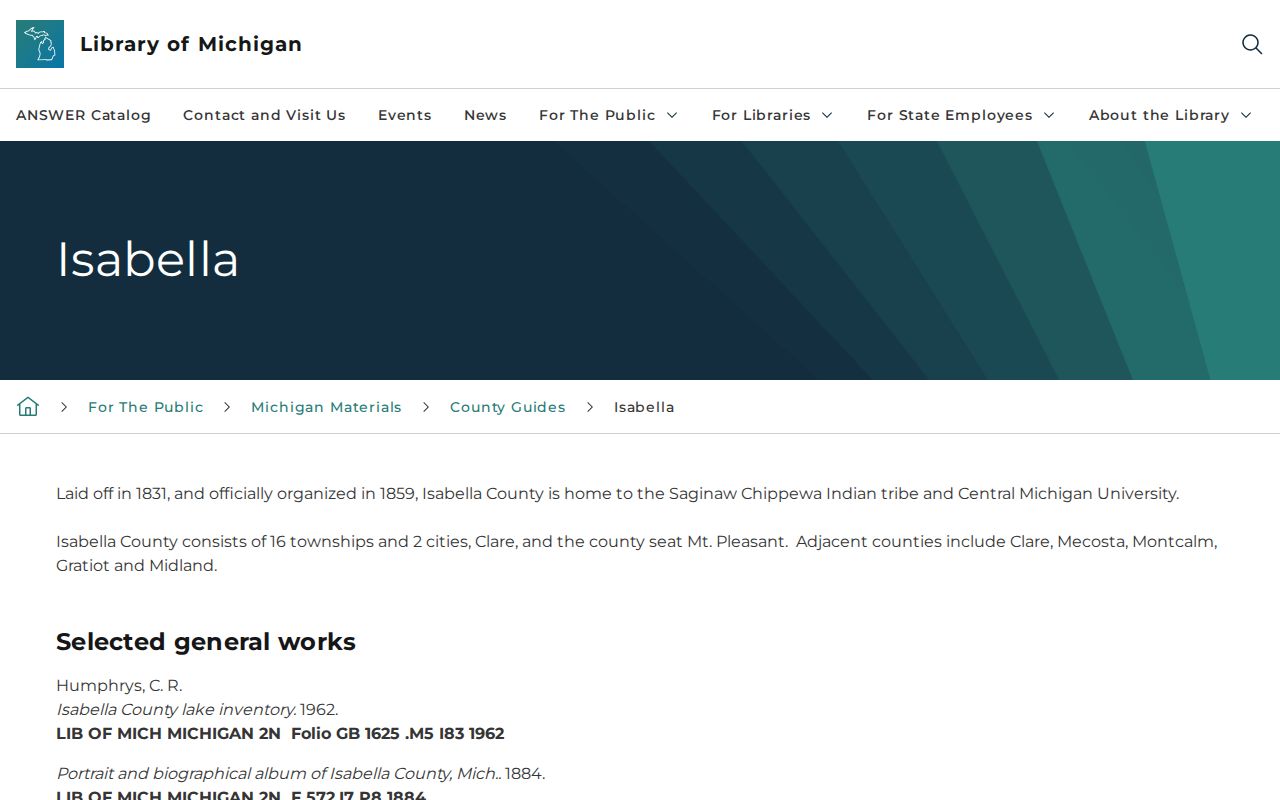
Plan the archive search with the guide, then confirm every ownership transfer in the official deed record.
Property Cases Run Through Three Isabella County Courts
Property disputes in Isabella County land in three courts. The 21st Circuit Court handles quiet title, foreclosure, and higher-value civil disputes, while the 76th District Court covers land-contract forfeiture and possession matters. The 37th Probate Court explains how an estate moved an interest before a later deed was recorded. Each court plays a different role.
MiCOURT Case Search filters by county and offers party or case-number fields. Its results are informational rather than the official court record. Use it to spot a case. Then ask the right court clerk for the file or a certified copy. Sealed material stays off limits. A docket entry is not the full order, judgment, or recorded title instrument.
Local Permit Records Depend on the Isabella County Address
No countywide portal holds every Isabella County permit. Mount Pleasant runs its own assessment, planning, and building routes, including an online permit-entry path. Lake Isabella publishes permit guidance and a detailed zoning application asking for the parcel, property address, zoning district, owner, and representative. Shepherd posts current zoning and site-plan materials. The village offers no address-keyed permit search. Other townships may use county Community Development or their own officials.
Check the governing jurisdiction before requesting a file. A mailing address or ZIP proves nothing about city or village boundaries. Match the BS&A municipality, FetchGIS layers, and the legal description, then contact the office that issued the approval. Private deed restrictions are a separate recorded or association matter. They are not public zoning.
When an Isabella County Portal Stops Short
Online access is only the first step. The Register of Deeds offers office search help, a public counter, land-record instructions, and copy services. Older land work can continue through tract indexes, deed books, and plat books. The Library of Michigan, Clarke Historical Library, and local microfilm hold further material. Court searchers can use the courthouse public-access terminal. Ask the proper clerk for a case or party record.
Michigan FOIA covers records that no routine service provides. Any person may send a written request to the public body holding the record. Describe the record well enough to locate. The normal response period is five business days. A written extension can add up to ten more. FOIA cannot force an office to create an analysis, disclose an exempt record, or certify a land-title conclusion.
Recent Isabella County Notices Need Source Checks
Fresh notices deserve an official-date check. Isabella County posted a 2026 tax-sale and surplus-proceeds calendar. Its tax pages explain that foreclosure follows Michigan's post-1999 tax-reversion process. A tax-sale notice, a delinquency entry, and a Register of Deeds instrument mark different stages. Read the parcel identifiers and dates. No single notice proves present ownership.
After the county's April 2026 warning about fake Planning and Zoning bills, verify any charge through the department and its published contacts before paying. Lake Isabella's cityhood exploration is still changing. Boundary maps and legal descriptions are part of that public process. The village has not become a city. Date every screenshot and revisit the issuing office.
Limits of Isabella County Property Records
Isabella County property records answer many questions about land and ownership. A tax roll names the owner of record. A deed record shows when a parcel changed hands. Assessment figures, recorded encumbrances, and plat maps all sit in the same body of material. Still, the records have real limits that a careful reader should understand.
No file can promise a complete list of every interest in a property. Recorded documents do not settle surveyed boundaries. They do not prove who actually occupies a home. They do not predict what a parcel will sell for. A current tax roll can also lag behind a recently recorded deed. Text pulled from an image by optical recognition can miss words entirely. Use these records for lawful diligence, boundary research, estate work, tax questions, and civic transparency. Michigan's Address Confidentiality Program gives eligible survivors a designated address with mail forwarding. That is one reason to handle public records with care. For consequential findings, confirm with the custodian, a title professional, a licensed surveyor, or qualified counsel as the situation requires.
Lawful use. A public search is not permission to watch, threaten, or harass anyone, and it is not a title search or boundary survey.